RSS

Will the Alberta Referendum Affect Edmonton Home Prices?

Short answer: Not directly. On October 19, 2026, Albertans vote on ten non-binding questions, and nothing on the ballot changes your title, your mortgage, your closing date or your property taxes the next morning. Edmonton prices are being set by three other things: how many homes are for sale, interest rates, and how many people are moving here. The one thing the vote could touch, slowly, is that last one.

By Jay Lewis, REALTOR® | RE/MAX Excellence · Updated October 4, 2026

Free download: my New-Construction Buyer Checklist. Two printable pages, from your first show home visit to your one-year warranty.

I'm not going to tell you how to vote. That isn't my job. I've worked in new construction for more than 25 years, on the trades side (framing, renovations and full contract builds) and the sales side. What I can do is what I do on a job site, which is separate what's holding the house up from what's just noise. Here is what the vote is, what it isn't, and what is moving home values in Edmonton right now.

House keys, a coffee mug and a notebook on a kitchen table in morning light, with autumn trees outside the window

Illustrative image.

What are Albertans voting on October 19?

Ten questions, each on its own colour-coded ballot (mail-in ballots are all white). Elections Alberta lists the results of all ten as not binding.

  • Questions 1 to 4 are about immigration and who qualifies for provincially funded programs.

  • Question 5 asks about requiring proof of citizenship to vote in provincial elections.

  • Questions 6 to 9 are constitutional, such as abolishing the Senate and how judges are chosen.

  • Question 10 is the one everyone is talking about.

Question 10 is not a yes or no question. You choose one of two options:

  • "Alberta should remain a province of Canada", or

  • "The Government of Alberta should commence the legal process required under the Canadian Constitution to hold a binding provincial referendum on whether or not Alberta should separate from Canada".

So the second option does not separate Alberta from Canada. It asks the government to start a legal process toward a possible future vote, and that future vote is the one that would count. The Premier has said the government will respect the result and that she will be voting for Alberta to remain in Canada.

Polls are open 9 a.m. to 8 p.m. on October 19, and advance voting runs October 13 to 17.

How far is a vote from actually leaving?

A long way. The Supreme Court of Canada ruled in 1998 that a province has no right to leave on its own. A clear majority on a clear question only creates a duty to negotiate, and the federal Clarity Act lets the House of Commons decide whether the question and the majority were clear.

Treaty rights are part of it too. Most of Alberta is covered by Treaties 6, 7 and 8, all signed before Alberta became a province in 1905. In May 2026 an Alberta court found the province had breached its duty to consult First Nations on an earlier citizen petition for an independence vote. That ruling is under appeal, and it is the reason Question 10 is worded the way it is.

What do the polls say, and what about Edmonton?

The polling has been steady. In August, the Angus Reid Institute asked Albertans the exact ballot question: 61% chose remain and 33% chose to start the process. Asked a simpler stay-or-leave question, it was 65% to 30%. An Ipsos poll in September had 70% for remain and 20% for starting the process.

Edmonton leans further toward staying than the province as a whole. That same Ipsos poll found 79% of Edmontonians choosing remain.

Two things keep it from being a sure thing. In the Angus Reid poll, 88% of people on the "start the process" side said they were certain to vote, compared with 81% on the remain side. And turnout looks high: about 658,000 Albertans requested mail-in ballots, compared with fewer than 60,000 in the 2023 provincial election.

What changes for your home on October 20?

Does not change with either result:

  • Who owns your home (your title)

  • Your mortgage contract and rate hold

  • Your closing date

  • Your property taxes

Could change slowly, over years:

  • Business confidence and hiring

  • How many people choose to move here

  • The tax base

If you have a mortgage approval in place and the vote has you frozen, call your mortgage broker and ask plainly: "Has anything changed about my approval or my rate hold because of the referendum?" In almost every case the answer will be no, and it's worth more hearing it from the person who holds your file. If you don't have a broker, the team at Mortgages For Less can answer that for you.

What is actually setting Edmonton home prices right now?

Three things, and none of them is on the ballot.

1. How many homes are for sale

This is the big one in Edmonton. In September 2026 the REALTORS® Association of Edmonton reported:

  • Sales: 1,959, down 10.3% from a year earlier.

  • New listings: 3,864, up 11.3%.

  • Inventory: 8,062 homes for sale, up 16.7%.

  • Average price: $466,080, up 2.9% from a year earlier. The benchmark price was $423,100, down 0.3%.

  • Detached homes: average $569,820, up 2.9%.

  • Townhouses: average $289,640, down 4.5%.

  • Apartment condos: average $208,672, up 0.6%.

  • Days on market: 44 on average, five more than a year ago.

That works out to roughly four months of inventory: a balanced market that has been tipping toward buyers. The Association's chair said rising inventory "could soften that growth even further". The Association's releases for July, August and September don't mention the referendum at all. They point to seasonality and supply.

The supply came from building that started years ago. Edmonton had 21,337 housing starts in 2025, and CMHC counted 18,544 homes under construction in the Edmonton area in August 2026.

I see it in my own MLS® searches for new family homes around Edmonton this week. New-construction inventory is sitting at about 7 to 9 months in Leduc, Fort Saskatchewan and Spruce Grove, while resale family homes in those same places are at 1 to 3 months. That gap is about how many homes builders have finished. It has nothing to do with the vote. I explain how to use it in new construction vs. resale.

2. Interest rates

The Bank of Canada's policy rate is 2.25%. It held there on September 2, and its next decision is October 28, 2026, nine days after the vote. The Bank sets rates for the whole country no matter how Alberta votes.

3. How many people are moving here

The Edmonton area grew 3.0% in the year to July 1, 2025, the fastest of any metropolitan area in Canada, with the largest gain from other provinces. Growth has cooled since: Alberta's population was up 1.5% in the year to July 1, 2026. That is still the fastest of any province, and people moving from other provinces have added to Alberta for 20 quarters in a row. The slowdown came mostly from lower federal targets for temporary residents.

Is Edmonton different from Calgary?

A few things are different here:

  • Prices are lower. Edmonton's benchmark price in September was $423,100. Calgary's was $566,700. That is about $143,600, or 25%, less.

  • Prices are holding. Edmonton's benchmark was down 0.3% from a year earlier and Calgary's about 1%. In August, Greater Toronto was down about 4.5% and Metro Vancouver about 5.6%.

  • Affordability is the draw. RBC estimates that owning a home in Edmonton took about 37% of a typical household's income in early 2026, compared with 53% nationally.

  • Support for staying is higher here than in the province overall, as the polling above shows.

So is there any real risk to home values?

Yes, and I'd be doing you a disservice to say otherwise. It just isn't a next-morning risk.

The risk is confidence. If businesses hold back on hiring or expanding, fewer people move here, and people are the slowest of the three drivers to show up in prices and the biggest. Business groups have said so. The head of the Edmonton Chamber of Commerce said in June that the debate is "chilling the brand", and Edmonton's mayor has said it creates "severe economic uncertainty". A Calgary Chamber survey of 137 members in June found 80% saying the debate was hurting Alberta's economy. University of Calgary economist Trevor Tombe estimated that a shock to confidence like the recent trade dispute could cost about 50,000 jobs, and he said himself to take that number with "several grains of salt".

Supporters of independence make the opposite case, that Alberta would be better off financially, and the frustrations behind the vote are real and long-standing. I'm not here to settle that.

What I can tell you is what the numbers show so far. I haven't found a source that has measured any effect of the referendum on Edmonton home prices or sales. Anyone telling you it has already moved prices, in either direction, is guessing.

Should you buy or sell before the vote, or wait?

Make the decision on your own plan, not on the ballot.

  • Buying a resale home: good family homes in many areas still sell in a few weeks. Waiting for a vote result doesn't change that.

  • Buying new construction: builders with finished homes are already negotiating on upgrades, closing costs or price. That leverage comes from inventory, and it's there this month.

  • Selling: you are competing with more listings than a year ago, so price and presentation matter more than timing the vote.

I also list homes for some builders. If you're interested in one of them, I'll tell you up front and explain how representation works.

Get my free New-Construction Buyer Checklist

If a new build is on your list this fall, the checklist walks you from your first show home visit to your one-year warranty.

Get the free checklist →

Frequently asked questions

When is the Alberta referendum?

Monday, October 19, 2026. Polls are open 9 a.m. to 8 p.m., and advance voting runs October 13 to 17.

Does the referendum separate Alberta from Canada?

No. All ten questions are non-binding. Question 10 asks whether Alberta should remain a province or whether the government should start the legal process toward a future binding referendum on separation.

Will my mortgage or rate hold change after the vote?

The vote doesn't change your mortgage contract. Rates follow the Bank of Canada and the bond market. If you have an approval, ask your mortgage broker directly whether anything has changed.

Has the referendum lowered Edmonton home prices?

There's no evidence of that so far. In September 2026 the average Edmonton-area price was $466,080, up 2.9% from a year earlier, and the benchmark price was down 0.3%. The market has softened because there are more homes for sale.

What matters more to Edmonton home values than the vote?

Supply, interest rates and migration. Inventory is up 16.7% from a year ago, the Bank of Canada rate is 2.25%, and population growth has slowed from its 2025 pace.

Thinking about a move this fall?

Text me first at 780-220-8449, or book a 20-minute call. I'll pull the current numbers for your neighbourhood and price range so you can decide on facts. No pressure. I work with buyers and sellers in Edmonton, Sherwood Park, Fort Saskatchewan, Devon, Spruce Grove, Stony Plain, St. Albert, Leduc and Beaumont.

Jay Lewis | REALTOR® | RE/MAX Excellence

Sources:Elections Alberta: 2026 referendum · Government of Alberta: Premier's address · Supreme Court of Canada: Reference re Secession of Quebec · Clarity Act · Angus Reid Institute, August 2026 · REALTORS® Association of Edmonton, September 2026 · CMHC housing starts, August 2026 · Statistics Canada: population of metropolitan areas · Statistics Canada: population estimates, July 1, 2026 · Bank of Canada, September 2, 2026 · RBC Economics: Housing Affordability, June 2026 · Calgary Real Estate Board, September 2026 · Ipsos poll, September 2026 (Global News) · Trevor Tombe, The Hub, February 2026

Want to see more Edmonton real-estate updates from JaySells.ca in Google? Add JaySells.ca as a Preferred Source.

This article is general information, not legal, tax, mortgage or political advice. Poll results and market statistics are estimates that change often with market conditions and world events. Home prices are averages and benchmarks, not a valuation of your home.

Read

Is Edmonton a Buyer's Market? What 18,544 Homes Under Construction Mean for You

Quick take: Edmonton's resale market softened in August, sales down, inventory up, prices flat to slightly lower, while the city simultaneously kept 18,544 homes moving through construction, one of the strongest population-adjusted building rates of any major Canadian market. Those two facts are usually reported separately. Looked at together, they point toward more choice and more negotiating room for buyers over the months ahead, whether they're shopping resale or new construction.

This article is part of my Edmonton New Construction Buyer’s Guide.

Free download: my New-Construction Buyer Checklist. Two printable pages, from your first show home visit to your one-year warranty.

Edmonton Real Estate Market Snapshot  September 2026

The latest complete statistics available when this article was published cover August 2026, for Greater Edmonton (Edmonton and several surrounding municipalities), alongside CMHC's newest construction data reported September 16, 2026.

Sources: REALTORS® Association of Edmonton, August 2026 statistics; CMHC, Fall 2026 Housing Supply Report and August 2026 construction data; Bank of Canada, September 2, 2026 rate decision.

For current advertised mortgage-rate examples, see MortgagesForLess.ca's Alberta mortgage rates. For Bank of Canada announcements and local context, see Edmonton Home Team's Bank of Canada updates. Actual mortgage rates vary by lender, down payment, mortgage-insurance status, amortization, property and borrower qualifications.

What the Board's Own Numbers Show

  • Sales: 2,143 residential sales in August, down 15.4% from July and down 9.8% from a year earlier

  • New listings: 3,769, down 8.1% month over month but still up 3.3% year over year

  • Inventory: 15.1% higher than August 2025

  • Average selling price: $469,602, down 1.1% from July but up 1.8% year over year

  • MLS® HPI composite benchmark price: $426,900, down 0.6% from July and down 0.6% from August 2025

  • Sales-to-new-listings ratio: approximately 56.9% (2,143 sales ÷ 3,769 new listings)

The REALTORS® Association of Edmonton didn't officially call this a buyer's market. But its own language is worth paying attention to, the Association said there are indicators that "a shift in the wider market is taking place," and warned that ample supply without enough demand could put downward pressure on prices beyond normal seasonal patterns.

That sales-to-new-listings ratio of 56.9% still sits inside the standard "balanced" range on paper. What matters more is the direction: sales falling, inventory building, the benchmark price softening, and the board itself flagging what could happen next if demand doesn't keep pace.

Meanwhile, Edmonton Keeps Building

CMHC's newest data shows Edmonton had 18,544 homes under construction in August 2026, up from 18,289 in July. The pipeline has grown every month since spring:

  • May: 17,440

  • June: 17,878

  • July: 18,289

  • August: 18,544

The growth rate is slowing, though:

  • May → June: +2.5%

  • June → July: +2.3%

  • July → August: +1.4%

At the same time, approved units waiting to start construction have moved from 5,503 in June to 5,316 in July and 5,262 in August. That doesn't mean Edmonton builders have stopped building, they haven't. It means a very large amount of housing is still moving through the pipeline, while there are early signs worth watching around what comes next.

Edmonton Is Still Building at One of the Strongest Rates Among Major Canadian Markets

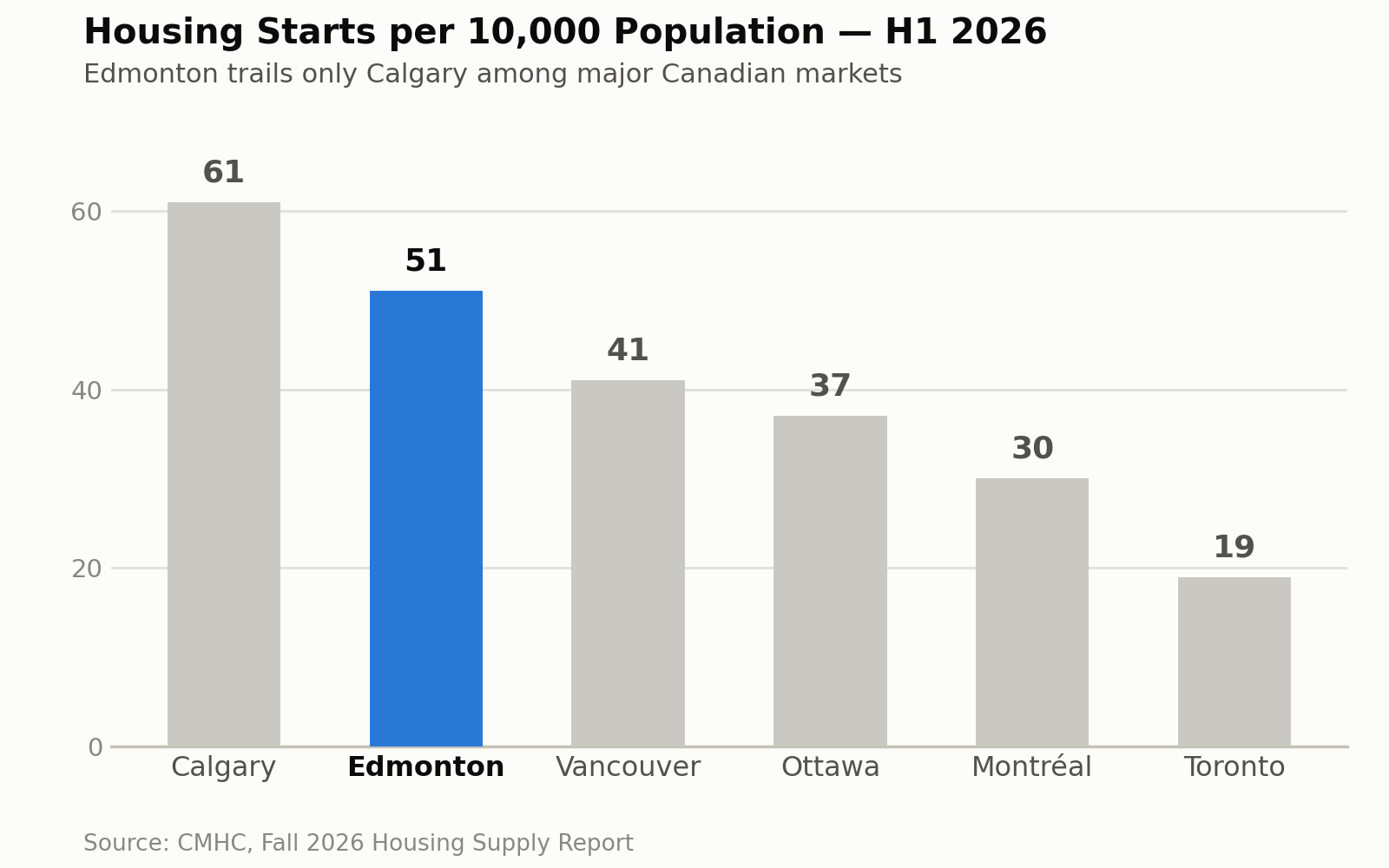
A raw number like 18,544 doesn't tell you whether that's actually a lot relative to the size of the city. CMHC's Fall 2026 Housing Supply Report answers that by comparing housing starts per 10,000 residents across major Canadian markets for the first half of 2026:

  • Calgary: 61

  • Edmonton: 51

  • Vancouver: 41

  • Ottawa: 37

  • Montréal: 30

  • Toronto: 19

Bar chart of housing starts per 10,000 people in the first half of 2026: Calgary 61, Edmonton 51, Vancouver 41, Ottawa 37, Montreal 30, Toronto 19 (source: CMHC)

Among the six markets CMHC compared, only Calgary built more per capita. Edmonton's rate is down about 20% from the unusually high pace set in 2025, but CMHC's own report notes construction here "remains above historical averages", meaning this is a slowdown from a very high level, not from a low one. A significant amount of housing is already committed and will keep moving toward completion regardless of what resale demand does in the short term.

Why Completions Bounce Around So Much

July completions jumped to 1,729 units. In August they dropped 11.4% to 1,532. I wouldn't read too much into either month by itself.

Multi-family construction makes completion numbers naturally lumpy. If a large apartment project finishes, hundreds of units can move into the completed category at essentially the same time, July's 1,729 completions included 908 apartment units, more than half the total, almost certainly reflecting one or two larger buildings wrapping up at once. The next month can then show a substantial decline without anything fundamentally changing in the market. That's why the overall construction pipeline is more informative than whether completions happen to be up or down in any single month.

What This Means If You're Buying

  • You likely have more room to compare homes, neighbourhoods, builders and specifications than you did a year ago, rather than feeling pressure to jump at the first listing that fits.

  • New construction and resale increasingly compete for the same buyers, a family looking at a detached home might be comparing a five-year-old resale property with a quick-possession home from a builder.

  • If you're considering new construction, look at the all-in price, not just the advertised base price. Confirm whether GST is included and whether the builder's price assumes an available rebate. Qualifying first-time buyers may be eligible for up to $50,000 through the [First-Time Home Buyers’ GST Rebate]. Builder incentives, such as appliances, air conditioning, landscaping, upgrades or possession terms, should also be valued based on what they are actually worth to you.

    Financing conditions matter too. Buyers should compare current mortgage rates, but amortization can matter just as much. If your down payment is less than 20%, a 30-year insured mortgage may be available if you're a first-time buyer and/or purchasing a new build. See my 2026 guide to 30-year mortgages in Alberta for the current rules and payment trade-offs.

If you want a second set of eyes on a specific listing or builder offer before you commit, call or text Jay Lewis at 780-220-8449 no pressure, just a sounding board.

What This Means If You're Selling

  • Understanding your competition matters more than it did a year ago, and your competition may not just be another resale home down the street. If you're near an active new community, buyers may be comparing your home against a brand-new property.

  • That comparison isn't purely about price. A resale home may already have landscaping, fencing, a deck, window coverings, appliances or a finished basement; a new home may offer warranty coverage and modern systems. Buyers weigh the whole package.

  • With inventory up 15.1% year over year, accurate pricing from the start matters. Overpricing into a market with this much competing supply typically means a longer time on market and eventual price reductions.

If you're weighing when to list or how to price against nearby new construction, reach out to Jay Lewis at 780-220-8449 or jay@jaysells.ca for a current comparison of your specific street.

What This Means If You're Building or Considering New Construction

  • A growing under-construction count paired with a shrinking not-yet-started pool suggests the next wave of completions will land in a resale market that's already softening, worth factoring into your timing if you have flexibility.

  • If you want a deeper comparison of the two paths, I've written a full guide to new construction vs. resale homes in Edmonton, covering warranty coverage, GST treatment, contract terms and what to watch for with a builder's sales representative.

  • Before you register with or visit a builder's show home, contact Jay Lewis at 780-220-8449 if you want your own representation, builder cooperation and registration policies vary, and some require your REALTOR® to be identified at the first visit.

So, Is Edmonton Becoming a Buyer's Market?

The numbers tell us something more useful than the label. Inventory is higher, sales are lower, the benchmark price has softened slightly, and the REALTORS® Association of Edmonton is openly warning that prices could face additional downward pressure if demand doesn't keep pace with supply. That's a market shifting in the buyer's direction.

But Edmonton isn't experiencing a housing-market collapse. The benchmark price is only 0.6% lower than a year ago, while the average selling price remains 1.8% higher. Both things can be true at once: buyers can be gaining leverage without prices falling dramatically.

What I'm Watching Next

The more interesting question isn't whether we can officially call Edmonton a buyer's market today, it's what happens next. Resale inventory is already elevated and demand has softened, while 18,544 homes remain under construction and Edmonton posts one of the strongest population-adjusted building rates among major Canadian markets. If resale inventory stays elevated while that construction pipeline moves toward completion, buyers could gain additional leverage. If demand strengthens enough to absorb the new supply, the picture could shift again. That's why I'm watching the pipeline, not just this month's sales number.

For buyers right now, the important thing is that you have something valuable: more choice. Use it.

Get the New-Construction Buyer Checklist

Trying to decide between new construction and resale in Edmonton or the surrounding area? Contact Jay Lewis for a new-construction buyer checklist and a side-by-side comparison of what your budget can buy in both markets.

Call or text Jay Lewis: 780-220-8449 Email: jay@jaysells.ca Website: jaysells.ca

Get my free New-Construction Buyer Checklist

Thinking about a new build? My free, printable 2-page checklist covers what to check at every stage, from your first show home visit to your one-year warranty.

Get the free checklist →

Frequently Asked Questions

Is Edmonton a Buyer's Market in 2026?

Edmonton is showing more buyer-friendly conditions, but the market is not uniform across every neighbourhood, property type or price range. In August, inventory was 15.1% higher than a year earlier while residential sales were 9.8% lower. The better takeaway is that many buyers have more choice and negotiating room than they did earlier in the year.

How Many Homes Are Under Construction in Edmonton?

CMHC reported 18,544 homes under construction in the Edmonton CMA in August 2026, up from 18,289 in July.

Is Edmonton Still Building a Lot of Homes Compared With Other Canadian Cities?

Yes. Edmonton recorded approximately 51 housing starts per 10,000 residents in the first half of 2026, placing it among the highest construction rates of the major markets compared in the CMHC report.

Why Are So Many Homes Still Under Construction if the Market Is Slowing?

Construction responds to changing conditions with a delay. Homes and multi-family projects that are already underway continue toward completion even when resale demand begins to soften.

Could More New Construction Push Edmonton Home Prices Lower?

More supply can increase buyer choice and competition, but construction alone does not determine prices. Demand, population growth, interest rates, location, property type and the pace at which inventory is absorbed all matter.

Should I Wait to Buy a Home in Edmonton?

There is no reliable way to identify the exact bottom of a housing market in advance. More inventory can create better selection and negotiating opportunities, but the decision should depend on the specific property, your financing, your timeline and how long you expect to own the home.

Why Did Edmonton Home Completions Drop in August?

Monthly completions can vary significantly, particularly when large multi-family projects finish in batches. One month's decline does not necessarily indicate that construction activity has stopped or materially changed direction.

Sources and Important Information

Thinking About Buying in Edmonton?

If you're comparing your options or planning a move in Edmonton, Sherwood Park, Fort Saskatchewan, Devon, Spruce Grove or Stony Plain, I can help you understand how the details fit into the bigger picture. With more than 25 years in new construction, on the trades and sales sides, I bring a builder’s eye perspective to the buying process.

Call or text Jay Lewis at 780-220-8449

Jay Lewis | REALTOR® | RE/MAX Excellence

Want to see more Edmonton real-estate updates from JaySells.ca in Google? Add JaySells.ca as a Preferred Source.

This article provides general information only and is not legal, tax, accounting or mortgage advice. Real-estate market statistics, construction data and mortgage rates can change. Confirm information that applies to your specific transaction with the appropriate qualified professional. The August 2026 completions figure for Edmonton is cited as reported by CMHC's September 16 release.

Read
Data last updated on October 16, 2026 at 09:30 PM (UTC).
Copyright 2026 by the REALTORS® Association of Edmonton. All Rights Reserved.
Data is deemed reliable but is not guaranteed accurate by the REALTORS® Association of Edmonton.
The trademarks REALTOR®, REALTORS® and the REALTOR® logo are controlled by The Canadian Real Estate Association (CREA) and identify real estate professionals who are members of CREA. The trademarks MLS®, Multiple Listing Service® and the associated logos are owned by CREA and identify the quality of services provided by real estate professionals who are members of CREA.
Text Jay