
<
RSS

New Construction vs. Resale Homes in Edmonton: Which Is Better in 2026?

Short answer: Neither option is automatically better. New construction offers current building standards, mandatory warranty protection on most qualifying homes, and opportunities to choose finishes or structural options. Resale offers established neighbourhoods, a negotiated possession date, and generally no GST on a typical previously occupied home. The right choice depends on your budget, preferred location, timeline, tolerance for construction uncertainty and the total cost of each property.

If you are buying in Edmonton or the surrounding area in 2026, compare the two options using all-in costs, not only the advertised price.


Edmonton Real Estate Market Snapshot — September 2026

The latest complete statistics available when this article was published cover August 2026. The figures below are for the Greater Edmonton Area (GEA), which includes Edmonton and several surrounding municipalities.

Market indicatorAugust 2026
Average MLS® residential selling price$469,602 (+1.8% year over year)
Median MLS® residential selling price$439,000 (+0.9% year over year)
MLS® HPI composite benchmark price$426,900 (−0.6% year over year)
Single-family HPI benchmark priceApproximately $525,000 (−0.2% year over year)
Residential inventory8,052 properties (+15.1% year over year)
Months of inventory3.8 months
Average days on market for monthly sales41 days, compared with 37 days in August 2025
Residential sales2,143 (−9.8% year over year)
Bank of Canada policy rate2.25%, held September 2, 2026
Advertised five-year fixed mortgage ratesApproximately 4.09%–4.64%, depending on the mortgage and borrower

Sources: REALTORS® Association of Edmonton — August 2026 statistics and Bank of Canada — September 2, 2026 decision.

For current advertised mortgage-rate examples, see MortgagesForLess.ca’s Alberta mortgage rates. For Bank of Canada announcements and local context, see Edmonton Home Team’s Bank of Canada updates. Actual mortgage rates vary by lender, down payment, mortgage-insurance status, amortization, property and borrower qualifications.

See MortgagesForLess.ca’s Alberta mortgage rates, and the Edmonton Home Team Bank of Canada updates for additional context.


What the 2026 Market Means for Buyers

The August numbers point to a market with more supply and slower sales than one year earlier. Inventory was 15.1% higher, sales were 9.8% lower and properties that sold took an average of 41 days rather than 37.

That does not mean every property is easy to negotiate. Conditions vary by municipality, neighbourhood, price range and property type. Attractive homes that are priced appropriately can still sell quickly, while properties that miss the market may remain available longer.

For buyers, the practical message is straightforward: there may be more opportunity to compare properties and negotiate than there was in a tighter market, but strong listings can still require prompt decisions.

New construction adds another layer of supply that MLS® statistics do not fully capture. As of September 2026, Livabl listed approximately 299 new-home communities, including 181 single-family communities, 2,827 floorplans and units, and 946 quick-possession homes in its Edmonton search area.

Those figures are not directly comparable with MLS® inventory. Livabl’s database includes developments that are planned, under construction or recently completed, along with builder inventory that may or may not be listed on MLS®. The numbers are useful as an indication of the size of the broader new-construction market—not as a count of communities with homes available for immediate purchase. Not every new-construction opportunity is advertised on MLS®. Contact Jay Lewis at  780-220-8449 before registering with or visiting a builder to compare MLS® listings with builder-marketed quick-possession and to-be-built homes that may be available.


Option 1: Buying New Construction

What new construction can offer

A home built to current requirements. A newly permitted home must meet the building requirements applicable to its construction. Newer homes commonly include updated insulation, air-sealing, windows and mechanical systems compared with older homes that have not been upgraded. Actual utility costs still depend on the home’s size, design, systems, weather and occupants’ energy use.

Mandatory warranty protection on most qualifying new homes. Under Alberta’s New Home Buyer Protection Act, most new homes with building permits applied for on or after February 1, 2014 require warranty coverage. The minimum protection is:

  • One year for labour and materials

  • Two years for defects in delivery and distribution systems, including electrical, plumbing, heating, ventilation and air conditioning

  • Five years for the building envelope

  • Ten years for major structural components

There are limited exemptions, including certain authorized owner-built homes. Coverage also has terms, limits and exclusions. Alberta new-home warranty overview.

Opportunities to personalize the home. Depending on when you purchase and what the builder permits, you may be able to choose finishes, cabinetry, flooring, countertops and fixtures. Some builders also offer structural options such as garage changes, additional windows, separate entrances or modified layouts. The options and deadlines vary by builder and stage of construction.

Potential GST relief for eligible buyers. Qualifying first-time buyers may recover up to 100% of the federal GST on a qualifying new home valued at $1 million or less, to a maximum of $50,000. The first-time-buyer rebate is reduced between $1 million and $1.5 million and is unavailable at $1.5 million or more. Eligibility and transaction dates matter.

Read the complete 2026 Alberta new-home GST rebate guide.

What buyers need to watch

The total price—not the base price. A builder’s starting price may not include the lot premium, preferred elevation, upgrades, landscaping, fencing, window coverings, appliances, deck, garage finishing or other items a buyer expects. GST may already be included in the advertised price, and the price may assume that an available rebate is assigned to the builder.

Before comparing a new home with resale, request a written breakdown of:

  • Base price and lot premium

  • Included specifications

  • Selected upgrades

  • GST and assumed rebates

  • Deposits and payment schedule

  • Closing adjustments

  • Items the buyer must complete after possession

Construction and possession timing. A home built from the ground up normally requires a much longer timeline than a typical resale purchase. The builder’s estimated possession date can change because of permitting, materials, labour, weather, inspections and other contract terms. A quick-possession home may be available considerably sooner, but the buyer has less opportunity to change the design and finishes.

Location and developing amenities. New greenfield construction exists around Edmonton’s outer south, southwest, west, southeast, northeast and north edges, as well as in surrounding municipalities. Choices vary by home type and builder.

New communities can involve ongoing construction, changing traffic patterns and amenities that are not complete. School sites and commercial areas shown on a concept plan do not guarantee a specific completion date. Buyers should verify the schools, transportation and services available today and recognize that school attendance boundaries can change.

The contract. Builder agreements are commonly written by the builder and can differ substantially from a standard resale contract. Buyers should understand deposit terms, financing conditions, construction changes, measurements, possession delays, closing adjustments, inspection rights and warranty procedures. Independent legal advice should be obtained before the agreement becomes firm.


The Builder’s Sales Representative and Your Representation

The builder’s sales representative works for the builder. Their role is not the same as having a real-estate professional representing the buyer’s interests.

Builder policies concerning REALTOR® cooperation and registration vary. Some require the buyer’s REALTOR® to accompany the buyer or be identified at the first visit or registration. If you want your own representation, contact your REALTOR® before visiting a show home, registering online or beginning direct negotiations with a builder.

Buyer representation can help with more than finding the development. It can include comparing lots, reviewing specifications and allowances, identifying omitted items, evaluating upgrade costs, understanding the builder’s paperwork, planning inspections, attending walkthroughs and documenting deficiencies. Legal questions and contract interpretation should still be handled by the buyer’s lawyer.


Inspections, Walkthroughs and Deficiency Lists on a New Home

A warranty is valuable, but it is not a substitute for careful inspections and documentation.

Depending on the builder, contract and stage of construction, a buyer may consider:

  • Reviewing plans, specifications and change orders during construction

  • Asking whether independent progress inspections are permitted

  • Completing a detailed pre-possession walkthrough

  • Recording incomplete or deficient work in writing

  • Learning the builder and warranty provider’s reporting deadlines

  • Considering an independent home inspection before possession or during the first warranty year

Warranty programs address eligible defects after the applicable requirements are met. Identifying and documenting concerns early can make them easier to address.

Jay Lewis reviewing construction details in a new Edmonton home

Illustrative image of Jay Lewis reviewing a new home’s construction details.

This is an area where my background matters. I bring more than 20 years of residential construction and real-estate experience, including framing, renovations, full contract builds, and helping clients buy and sell new-construction homes. I do not present myself as the builder or replace the work of inspectors, engineers or lawyers. My role is to help buyers ask better questions, compare what is included and recognize details that may deserve closer review.


Option 2: Buying a Resale Home
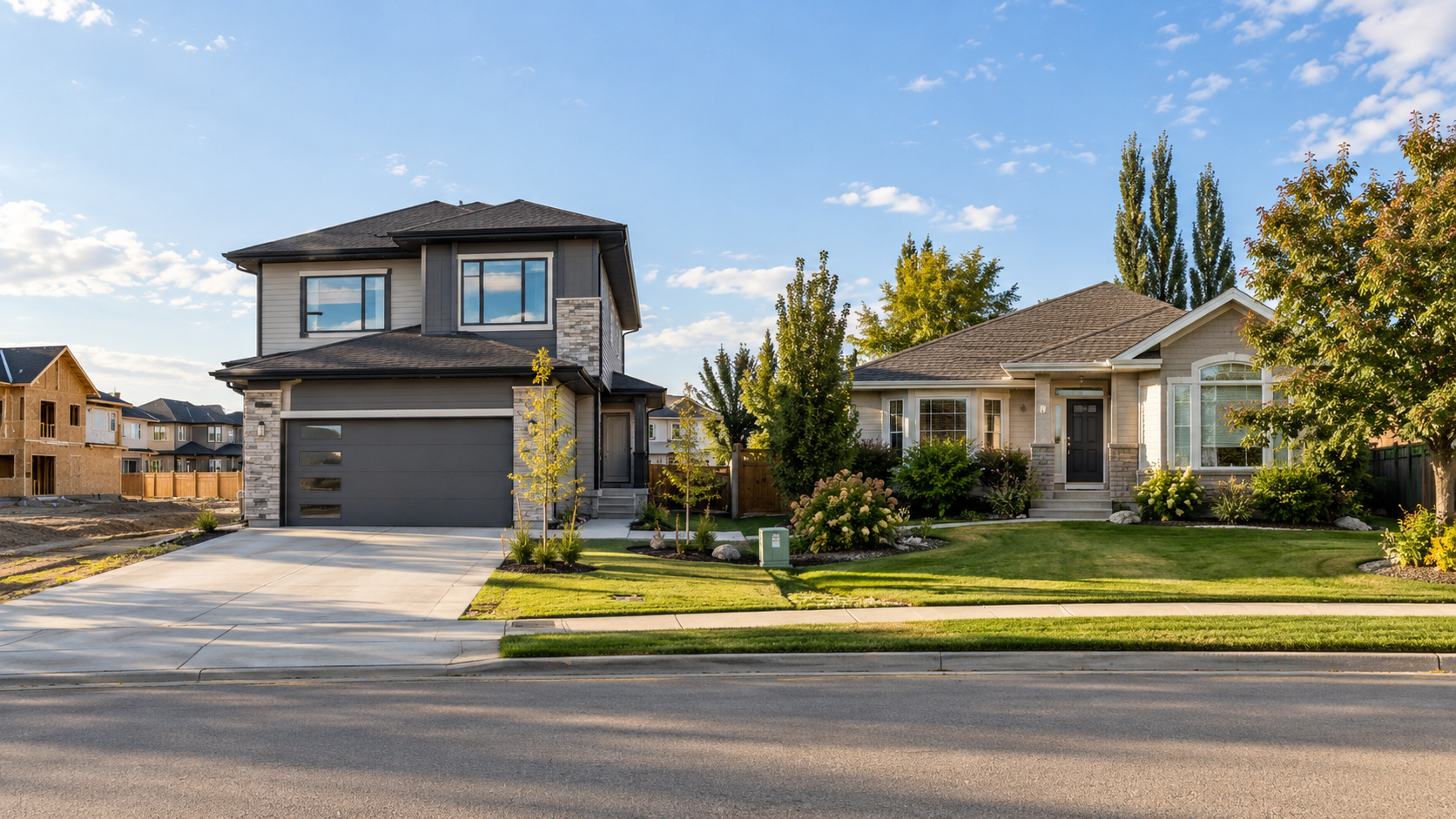
Resale homes in an established Edmonton neighbourhood

An established Edmonton-area streetscape, shown for illustration.

What resale can offer

Established locations. Resale gives buyers access to mature neighbourhoods, existing schools and services, established transit routes, completed landscaping and a wider range of locations. Buyers should still verify current school attendance areas and future plans rather than assume they will never change.

Generally no GST on a typical previously occupied home. Most ordinary sales of used residential homes are exempt from GST. Exceptions can arise, including certain substantially renovated properties or unusual transactions, so buyers should obtain tax and legal advice when the property’s history is unclear.

A negotiated possession date. Unlike a home that is still being constructed, a completed resale property allows the buyer and seller to negotiate a specific possession date in the purchase contract. The date is not solely the buyer’s choice—it must be accepted by both parties.

The ability to assess what already exists. Buyers can see the finished home, lot, street and surrounding development. A home inspection can help identify visible concerns before conditions are removed, although no inspection can guarantee that every concealed or future issue will be found.

What buyers need to watch

Age and condition. Roofing, windows, drainage, foundation, plumbing, electrical systems, heating equipment and previous renovations can all affect future costs. The home’s age alone does not determine its condition; maintenance and the quality of previous work matter.

Renovation costs. A lower resale purchase price may not remain lower after replacing flooring, kitchens, bathrooms, windows or mechanical systems. Compare the realistic cost of making the property work for you—not only its purchase price.

Remaining new-home warranty. A newer resale home may still have warranty protection. Alberta’s new-home warranty attaches to the home, not only to the original owner, and remains in effect after a resale until the applicable coverage expires. Buyers can search Alberta’s property registry and review the warranty documents to determine what remains.


The GST Difference: Compare the Contract, Not the Headline Price

New homes in Alberta are generally subject to 5% federal GST. A qualifying first-time buyer may receive substantial relief under the First-Time Home Buyers’ GST/HST Rebate, while another buyer may pay more GST on the same home.

That does not mean every eligible buyer receives money back after closing. The builder may credit an assumed rebate in the contract and require the buyer to assign the rebate to the builder. If the buyer does not qualify, the contract may require the buyer to pay the difference.

When comparing new construction with resale, determine:

  1. Whether the new-home price includes GST

  2. Whether an assumed rebate has already been deducted

  3. Which rebate the buyer may qualify for

  4. Who will apply for or receive the rebate

  5. What the buyer owes if the CRA denies the claim

Confirm the calculation with the builder, CRA, an accountant and your real-estate lawyer before relying on the rebate in your budget.


New Construction vs. Resale: Side-by-Side Comparison

ConsiderationNew constructionResale
GSTGenerally subject to 5% GST; rebates may be availableMost typical used-home sales are GST-exempt
WarrantyMandatory 1/2/5/10-year minimum coverage on most qualifying new homesA newer resale may retain the balance of its original new-home warranty
PossessionDepends on construction stage and contract; estimates may changeA specific date is negotiated between buyer and seller
CustomizationOften available when purchased early enoughExisting layout and finishes; renovations are completed after purchase
LocationCommon in developing areas, infill projects and surrounding municipalitiesBroad choice across established and developing neighbourhoods
Energy performanceBuilt to requirements applying at the time of constructionVaries by age, construction, upgrades and maintenance
Inspection needsWalkthroughs and independent inspections remain valuableA pre-purchase inspection is an important risk-management tool
Price comparisonMust include lot, upgrades, GST treatment and unfinished itemsMust include anticipated repairs, replacements and renovations
Neighbourhood certaintyFuture amenities and construction timelines may changeExisting surroundings are visible, although future change remains possible

Who Is Usually Better Suited to Each Option?

New construction may make more sense when you:

  • Have flexibility around the possession timeline

  • Value warranty protection and newer systems

  • Want to choose finishes or available design options

  • Are comfortable living in a developing area or buying infill

  • Are prepared to compare the complete specifications and all-in price

  • May qualify for the First-Time Home Buyers’ GST/HST Rebate

Resale may make more sense when you:

  • Need to negotiate a specific possession date

  • Want an established neighbourhood or particular location

  • Prefer to evaluate the completed home and surroundings

  • Want to avoid the uncertainty of a construction schedule

  • Find a home whose condition and renovation needs fit your budget

Many buyers will not know which option is better until they view both. Comparing resale properties in the locations you prefer with new homes at a similar all-in budget is often the clearest way to decide.


What Sellers Should Know in 2026

New construction is also part of the competition for resale sellers, particularly in areas near active developments.

A resale home may compete well by offering an established yard, completed window coverings, appliances, fencing, a deck, a finished basement, air conditioning or a faster and more dependable possession timeline. A new home may compete through warranty protection, modern design, builder financing promotions or buyer choice.

When pricing a resale property, sellers should compare more than another home’s advertised base price. The relevant comparison is the buyer’s likely finished, all-in cost and the value of what is already included in the resale property.

With Greater Edmonton inventory 15.1% higher than a year earlier, accurate pricing and clear presentation matter. That does not mean every seller must discount heavily; it means buyers have more alternatives and are more likely to compare value carefully.


My Take as a Local REALTOR®

New construction and resale are different products, and I do not believe buyers should decide between them based on assumptions.

With more than 20 years of residential construction and real-estate experience—including framing, renovations, full contract builds, and helping clients buy and sell new-construction homes—I look beyond the show-home finishes. The lot, specifications, allowances, upgrade pricing, contract terms, walkthrough process and items excluded from the price can matter as much as the floor plan.

Resale deserves the same practical analysis. An older home can be well built and carefully maintained, while a newer home can still require close inspection. The goal is not to declare every new home better than every resale home. It is to understand exactly what you are buying, what remains to be completed and what the full cost is likely to be.

My usual approach is to compare both options at the same time: resale homes in the locations the buyer actually wants and new-construction opportunities at a similar all-in budget. That comparison normally makes the trade-offs much clearer.


Get the New-Construction Buyer Checklist

Thinking about buying a new-construction or resale home in Edmonton or the surrounding area?

Contact me for my new-construction buyer checklist and a side-by-side comparison of what your budget can buy in both markets.

Call or text: 780-220-8449
Email: jay@jaysells.ca
Website: jaysells.ca

Contact me before registering online or visiting a builder if you want your own representation. Builder cooperation and registration policies vary.


Frequently Asked Questions

Is there GST on a resale home in Alberta?

Most sales of previously occupied residential homes are exempt from GST. Exceptions can apply, including certain substantially renovated properties and unusual transactions. Obtain professional advice if the property’s tax status is uncertain.

Do buyers always pay the full 5% GST on a new home?

No. Eligible buyers may qualify for the existing GST/HST New Housing Rebate, the First-Time Home Buyers’ GST/HST Rebate or another applicable housing rebate. The builder’s advertised price may also include GST and assume assignment of a rebate. Review the contract and confirm eligibility before relying on any rebate.

What warranty comes with a new home in Alberta?

Most qualifying new homes require minimum coverage of one year for labour and materials, two years for delivery and distribution systems, five years for the building envelope and ten years for major structural components. Coverage has conditions, exclusions and limits.

Does warranty coverage transfer when a newer home is resold?

Yes. Alberta states that the new-home warranty is attached to the home, not the owner, and remains in effect after resale until the applicable coverage expires.

How long does an Edmonton new home take to build?

There is no single reliable timeline for every home. It depends on the builder, permits, construction type, design selections, labour, materials, weather and contract. Ask for the builder’s current written estimate and review what the agreement permits if possession is delayed. Quick-possession homes are generally available sooner because construction is already underway or complete.

Can buyers negotiate with an Edmonton home builder?

Terms vary by builder, project, property and market conditions. Buyers can ask about the price, lot premium, included specifications, upgrades, appliances, landscaping, closing costs and current incentives. Compare the net value of the complete package rather than focusing only on a price reduction.

Where is new construction happening around Edmonton?

New construction is found around Edmonton’s outer south, southwest, west, southeast, northeast and north edges, through infill projects in established neighbourhoods, and in surrounding municipalities. Current availability varies by builder and housing type.

Is an inspection worthwhile on a new home?

Yes. A new-home warranty does not eliminate the value of inspections, walkthroughs and a detailed written deficiency list. Inspection opportunities depend on the builder contract and construction stage, so buyers should clarify their rights before signing.

Should I choose new construction or resale in 2026?

Choose based on the total cost, desired location, timeline, condition, warranty, included features and your comfort with construction uncertainty. The best decision normally comes from comparing actual homes in both categories rather than comparing general assumptions.


Sources and Important Information

This article provides general information only and is not legal, tax, accounting, engineering, inspection or mortgage advice. Real-estate market statistics, mortgage rates, builder inventory, incentives and government programs can change. Confirm information that applies to your transaction with the appropriate qualified professional.

Jay Lewis | REALTOR® | RE/MAX Excellence 

 Want to see more Edmonton real-estate updates from JaySells.ca in Google? Add JaySells.ca as a Preferred Source.

Read

Can You Get a 30-Year Mortgage on a New Build in Alberta? (2026 Update)

Yes. A 30-year insured mortgage may be available in Alberta when at least one borrower is a first-time homebuyer or the property is a newly built home that has not previously been occupied.

That second part is important: you do not necessarily have to be a first-time buyer if you are purchasing a qualifying new build.

A 30-year amortization can reduce the required monthly mortgage payment, but it normally means paying more interest and building equity more slowly. Buyers should compare both options before deciding that the lower payment is the better long-term choice.

Who Can Qualify for a 30-Year Insured Mortgage?

Under CMHC Home Start, a borrower may qualify through either of these routes:

  • At least one borrower is considered a first-time homebuyer; or

  • The property is newly built and has not previously been occupied as a residence.

The property must also:

  • Be intended for owner occupancy

  • Be located in Canada

  • Be suitable for year-round occupancy

  • Have a purchase price or lending value below $1.5 million

  • Be financed with a high-ratio mortgage, meaning the mortgage exceeds 80% of the property’s lending value

The maximum amortization available through CMHC Home Start is 30 years.

What Is a First-Time Homebuyer?

For this mortgage-insurance program, you may be considered a first-time homebuyer if you meet at least one of the following conditions:

  • You have never purchased a home in Canada.

  • During the current calendar year and previous four calendar years, you did not occupy a Canadian home owned by you or your current spouse or common-law partner.

  • You have lived separately from your spouse or common-law partner for at least 90 days because of a relationship breakdown and meet the applicable timing requirements.

These definitions are specific to the mortgage-insurance program. Other programs—including the FHSA, Home Buyers’ Plan and First-Time Home Buyers’ GST/HST Rebate—have their own eligibility rules.

Can a Repeat Buyer Get a 30-Year Mortgage on a New Build?

Potentially, yes.

A repeat buyer may qualify when purchasing a home that is newly built and has not previously been occupied for residential purposes. That could include a newly completed detached home, duplex, townhouse or condominium that meets the insurer and lender requirements.

For a new condominium, CMHC makes an exception for certain periods of interim occupancy before the condominium declaration is registered or before the buyer formally takes possession.

This makes the program relevant not only to first-time buyers but also to existing homeowners moving into new construction.

How Much Down Payment Is Required?

For an owner-occupied property containing one or two units, the minimum equity requirements are generally:

  • 5% of the first $500,000

  • 10% of the portion above $500,000

For example, the minimum down payment on a $700,000 home would be:

  • 5% of the first $500,000: $25,000

  • 10% of the remaining $200,000: $20,000

  • Total minimum down payment: $45,000

Homes priced at $1.5 million or more are not eligible for CMHC mortgage insurance and generally require at least 20% down.

Mortgage default insurance is normally required when the down payment is less than 20%. The insurance protects the lender—not the homebuyer—and its premium is typically added to the mortgage.

How Much Can a 30-Year Mortgage Lower the Payment?

Here is a simplified illustration using a $450,000 mortgage and a 4.5% interest rate:

AmortizationApproximate monthly paymentApproximate total interest
25 years$2,491$297,188
30 years$2,269$366,829

In this example, the 30-year amortization lowers the payment by approximately $222 per month, but adds approximately $69,641 in interest if the same interest rate continued for the entire amortization.

This illustration excludes mortgage-insurance premiums, property taxes, utilities and other ownership costs. Canadian mortgages are renewed periodically, so the actual interest paid will depend on future rates, payment changes and how quickly the mortgage is repaid.

Does Mortgage Insurance Cost More With a 30-Year Amortization?

It can.

CMHC’s published Home Start premiums are slightly higher than its standard 25-year CMHC Purchase premiums at comparable loan-to-value levels.

For example:

Loan-to-value ratioStandard CMHC Purchase30-year CMHC Home Start
80.01%–85%2.80%3.00%
85.01%–90%3.10%3.30%
90.01%–95%4.00%4.20%

The premium is a one-time mortgage-insurance charge that can generally be added to the insured mortgage amount.

Other mortgage insurers and lenders may have different products, requirements and premiums. Ask your mortgage professional to compare the complete cost—not just the monthly payment.

Will a 30-Year Amortization Help Me Qualify?

A longer amortization produces a lower scheduled mortgage payment, which may improve affordability calculations. It does not eliminate the mortgage stress test or guarantee approval.

For CMHC Home Start, the published maximum debt-service ratios are:

  • Gross Debt Service ratio: 39%

  • Total Debt Service ratio: 44%

The qualifying calculation uses the greater of:

  • The contract mortgage rate plus 2%; or

  • 5.25%

At least one borrower or guarantor must generally have a minimum credit score of 600, although the lender and insurer will consider the entire application.

Income, existing debts, property taxes, heating costs, condominium fees, down payment and credit history can all affect approval.

Is a 30-Year Mortgage Better Than a 25-Year Mortgage?

It depends on the buyer’s priorities.

A 30-year amortization may be helpful when:

  • A lower required payment creates needed monthly flexibility.

  • The buyer is purchasing a new build and expects additional expenses after possession.

  • The buyer plans to make extra payments when their budget permits.

  • The lower payment helps keep total housing costs manageable.

A 25-year amortization may be better when:

  • The buyer can comfortably afford the higher payment.

  • Paying less total interest is the priority.

  • The buyer wants to build equity faster.

  • The slightly lower mortgage-insurance premium is meaningful.

The safest approach is to compare the payment, insurance premium and long-term interest under both options.

Can You Combine a 30-Year Mortgage With the New GST Rebate?

Potentially, yes.

The 30-year insured-mortgage rules and the First-Time Home Buyers’ GST/HST Rebate are separate programs. A qualifying first-time buyer purchasing a qualifying new home may be eligible for both.

Under the GST rebate, eligible first-time buyers may recover up to 100% of the federal GST paid on a qualifying new home valued at $1 million or less, to a maximum rebate of $50,000. A partial rebate may be available between $1 million and $1.5 million.

Read more: What Is the GST Rebate on a New Home in Alberta? (2026 Update)

Qualification for one program does not automatically mean you qualify for the other. Confirm both separately.

Questions to Ask Before Choosing a 30-Year Mortgage

Ask your mortgage professional:

  • Do I qualify because I am a first-time buyer, because the home is newly built, or both?

  • What will my mortgage-insurance premium be?

  • How much will the 30-year option reduce my monthly payment?

  • How much additional interest could I pay?

  • Can I make lump-sum or increased payments without penalties?

  • What rate and payment should I prepare for at renewal?

  • How will property taxes, condominium fees and heating costs affect qualification?

  • Can I combine this financing with the new-home GST rebate, FHSA or Home Buyers’ Plan?

Buying a New-Construction Home in the Edmonton Area?

Financing is only one part of a new-build purchase. Buyers should also understand the builder’s specifications, upgrade pricing, deposits, construction timeline, GST treatment, closing adjustments, inspection rights and warranty coverage.

With more than 20 years of residential construction experience, I help buyers compare these details when purchasing new homes in Edmonton, Sherwood Park, Fort Saskatchewan, Devon, Spruce Grove and Stony Plain.

Call or text Jay Lewis at 780-220-8449

Jay Lewis | REALTOR® | RE/MAX Excellence | Lewis & Co. Realty

This article provides general information only and is not mortgage, financial, tax or legal advice. Mortgage products, qualification requirements and interest rates can change. Confirm your specific options with a licensed mortgage professional, lender and real-estate lawyer.

Official Sources

Information reviewed and updated September 4, 2026.

Read

You Can Buy a Home the Year You Graduate High School in Edmonton — Here's What That Actually Looks Like

Most 18-year-olds don't think about homeownership. They're thinking about summer jobs, maybe college in the fall, or figuring out what comes next. But here's something worth knowing: in Alberta, you can legally purchase a home the day you turn 18 — and in Edmonton specifically, the math of doing so is closer to realistic than most people would guess. This isn't a pitch to skip university and buy a condo. It's a look at what the numbers actually say, so you — or someone you care about — can make an informed decision.

The Price Point That Makes Edmonton Different

Edmonton apartment condos averaged $214,521 in July 2026. That's not a typo, and it's not a rough neighbourhood — it's the city-wide average across all condo sales. On a home in that range, the minimum down payment required in Canada is 5%, which works out to about $10,700. Closing costs in Edmonton — legal fees, home inspection, title insurance — typically run $3,000 to $5,000. So the realistic all-in number to get keys in hand is somewhere around $15,000 to $16,000.

That's a number a determined 18-year-old with a year or two of working can actually reach. Compare that to the same calculation in Vancouver or Toronto, where a condo routinely starts above $600,000, and Edmonton's advantage becomes very clear.

The FHSA Is the Most Important Account a Graduate Can Open

The First Home Savings Account is the piece of this puzzle most young people haven't heard of yet, and it's worth understanding immediately. Starting at age 18, you can contribute $8,000 per year into an FHSA — up to a $40,000 lifetime limit. Contributions are tax-deductible (like an RRSP), and withdrawals for a first home are completely tax-free (like a TFSA). It's the best of both worlds in one account.

If you open an FHSA at 18 and contribute the full $8,000 in year one, you've already got a meaningful head start on your down payment — and you've reduced your taxable income at the same time. Stack that with the RRSP Home Buyers' Plan (which lets first-time buyers withdraw up to $60,000 tax-free toward a purchase) and the First-Time Home Buyers' Tax Credit worth up to $1,500 back at tax time, and the federal government is genuinely helping you get there. Alberta adds one more advantage: no land transfer tax. Most provinces charge 1–2% of the purchase price at closing. In Alberta, you pay a flat registration fee — roughly $350 on a $500,000 home.

The Real Challenge Isn't the Down Payment — It's the Mortgage

Here's where I want to be straight with you. The down payment is achievable. Getting approved for a mortgage at 18 is the harder part. Lenders want to see a credit score of 680 or higher, stable employment income — typically two or more years of documented history — and a debt-to-income ratio where housing costs don't exceed 32% of gross income. For a condo in the $214,000 range, you'd need a household income in roughly the $40,000–$55,000 range annually to qualify.

That's not impossible for a recent grad with a full-time job — especially in Alberta's trades, energy, or tech sectors, where starting wages can clear that threshold. But it does mean the path to an 18-year-old buying solo is narrow. The more common version of this story involves a parent or family member co-signing the mortgage, which uses the co-signer's income and credit to help qualify while the young buyer builds their own history. Done carefully, this can work well — and it's worth a conversation with a mortgage professional to understand the implications for both parties.

What the Smartest Move Looks Like Right Now

If you're graduating this year and homeownership is somewhere in your thinking, the single best thing you can do today — before you buy anything — is open an FHSA and start contributing. Even $2,000 or $3,000 in the account this year means you're building tax-sheltered savings, establishing a financial record, and preserving future contribution room. Get a credit card with a small limit and pay it off in full every month. These two moves, started at 18, put you in a genuinely strong position by 20 or 21.

Edmonton is one of the few cities in Canada where this timeline is realistic rather than theoretical. The entry price point is real. The programs exist. The math can work. If you want to sit down and map out what a path to ownership could look like for your specific situation, that's a conversation I'm always glad to have.

Jay Lewis, Realtor | Edmonton & Area | Alberta Real Estate


FAQ

Can an 18-year-old buy a house in Alberta? Yes — Alberta's age of majority is 18, so a new graduate can legally purchase property and sign a mortgage the day they turn 18. The bigger hurdle is typically mortgage qualification, which requires documented income and a credit history.

How much do you need to buy a condo in Edmonton right out of high school? Edmonton condos averaged $214,521 in July 2026, making the minimum 5% down payment roughly $10,700. Add $3,000–$5,000 in closing costs and you're looking at approximately $15,000–$16,000 total to get started — one of the lowest entry points of any major Canadian city.

What is the First Home Savings Account and when should a grad open one? The FHSA lets first-time buyers contribute up to $8,000 per year (lifetime max $40,000), with tax-deductible contributions and completely tax-free withdrawals for a home purchase. New grads should open one as soon as they turn 18 — the earlier you start, the more tax-sheltered savings you accumulate before you buy.


Jay Lewis, Realtor | Edmonton & Area | Alberta Real Estate


Sources: Government of Canada — First Home Savings Account | CMHC Down Payment Requirements 2026 | REALTORS® Association of Edmonton July 2026 Statistics | Dustin Realty — First-Time Home Buyer Programs Alberta 2026 | Metro Mortgage Group — First-Time Home Buyer Edmonton Complete Guide 2026 | Clover Mortgage — Age Limits for Getting a Mortgage in Canada

Read

Rates Held, Inventory Up: Why Fall 2026 Is One of Edmonton's Most Balanced Markets in Years

Something shifted quietly this summer that's worth paying attention to heading into fall. After nine consecutive Bank of Canada rate cuts between June 2024 and October 2025 — dropping the policy rate from 5% all the way to 2.25% — the Bank has now held steady for six consecutive announcements, with another hold expected on September 2nd. Rates aren't going lower anytime soon, but they're also not going up. That kind of stability, combined with Edmonton's rising inventory, sets the stage for a fall market that looks quite different from anything we've seen in the past few years.

What "Balanced" Actually Means Right Now

Edmonton's sales-to-new-listings ratio sat around 53% in July, and inventory has climbed 22.2% year-over-year — running about 32.7% higher than where it was at the start of 2026. In practical terms, that means buyers have more homes to look at, more time to make decisions, and more room to include conditions in their offers. The frantic pace of 2024, where well-priced homes drew multiple offers within days, has eased.

That doesn't mean the market is soft. Average residential prices came in at $475,079 in July, up 2.6% from the same time last year. Detached homes are averaging $585,726. Prices aren't falling — they're just growing at a calmer, more sustainable pace. For buyers who've been sitting on the sidelines waiting for some kind of crash, this is the important signal: the market is moderating, not collapsing, and the window of relatively more choice may not last indefinitely.

The Rate Picture and What It Means for Your Mortgage

The best 5-year fixed mortgage rate available in Alberta right now is 4.24%, with the best variable sitting at 3.65%. After years of watching rates move dramatically in both directions, there's genuine value in knowing that the Bank of Canada is in a holding pattern — forecasters describe the current stance as an economic stalemate where inflation is too uncertain to justify a cut, and growth is too fragile to justify a hike.

For buyers, that translates to predictability. You can stress-test your numbers against a rate in the mid-4s and have reasonable confidence it's not going to look dramatically different by the time you close. For anyone who locked into a higher rate in 2022 or 2023 and has a renewal coming up, this fall is the time to start shopping your renewal early — rates today are meaningfully lower than the peaks, and getting ahead of that conversation by 90 days can make a real difference.

What Fall Traditionally Does to Edmonton's Market

Edmonton real estate follows a fairly consistent seasonal rhythm. Spring is the busiest buying season, summer cools slightly as families travel and take stock, and then fall — September through mid-November — brings a genuine second wave of activity. Buyers who paused over the summer come back with fresh urgency before the holidays, and sellers who've been watching the market list with realistic expectations.

This fall has an additional tailwind: population growth. Alberta continues to draw interprovincial migration at a steady pace, and Edmonton's rental market has remained tight, which pushes renters toward ownership when they can make the numbers work. The fundamentals that have supported Edmonton's market for the past few years — affordability relative to Vancouver and Toronto, no land transfer tax, a functioning energy economy — are still intact.

What This Means If You're Thinking of Moving

For buyers, fall 2026 offers something that was genuinely rare in 2024: conditions. The ability to include a home inspection, a financing condition, or a longer possession date without immediately losing the deal. That's not a small thing — it's protection, and it matters. You're not looking at a sea of bargains, but you're also not walking into a bidding war every weekend.

For sellers, the message is that pricing accurately matters more now than it did eighteen months ago. Overpriced listings are sitting. Homes that come in well-positioned for the current market are still selling at strong prices and moving in reasonable timeframes. The days of "list it and let the market do the work" are behind us — but a well-presented, properly priced home in Edmonton still has a very willing audience.

If you want to talk through what this market looks like for your specific situation, whether you're buying, selling, or thinking about timing a move, I'm always happy to have that conversation.

Jay Lewis, Realtor | Edmonton & Area | Alberta Real Estate


FAQ

Is fall 2026 a good time to buy a home in Edmonton? Fall 2026 offers more inventory, stable mortgage rates around 4.24% fixed, and more room to include conditions — making it one of the more buyer-friendly windows in recent years. Prices are still growing modestly year-over-year, so waiting for a significant dip is not a strategy the data supports.

Will Edmonton home prices drop in fall 2026? Current data doesn't point to a price drop — Edmonton's average residential price was $475,079 in July 2026, up 2.6% year-over-year. The market is moderating, not reversing, with balanced conditions and steady demand from population growth and affordability-driven migration.

Will the Bank of Canada cut rates again in fall 2026? The Bank of Canada has held its policy rate at 2.25% for six consecutive announcements and is expected to hold again in September. Further cuts appear unlikely through the end of 2026, as the Bank is navigating competing risks from inflation and slow growth.

Read
Data last updated on September 14, 2026 at 09:30 PM (UTC).
Copyright 2026 by the REALTORS® Association of Edmonton. All Rights Reserved.
Data is deemed reliable but is not guaranteed accurate by the REALTORS® Association of Edmonton.
The trademarks REALTOR®, REALTORS® and the REALTOR® logo are controlled by The Canadian Real Estate Association (CREA) and identify real estate professionals who are members of CREA. The trademarks MLS®, Multiple Listing Service® and the associated logos are owned by CREA and identify the quality of services provided by real estate professionals who are members of CREA.